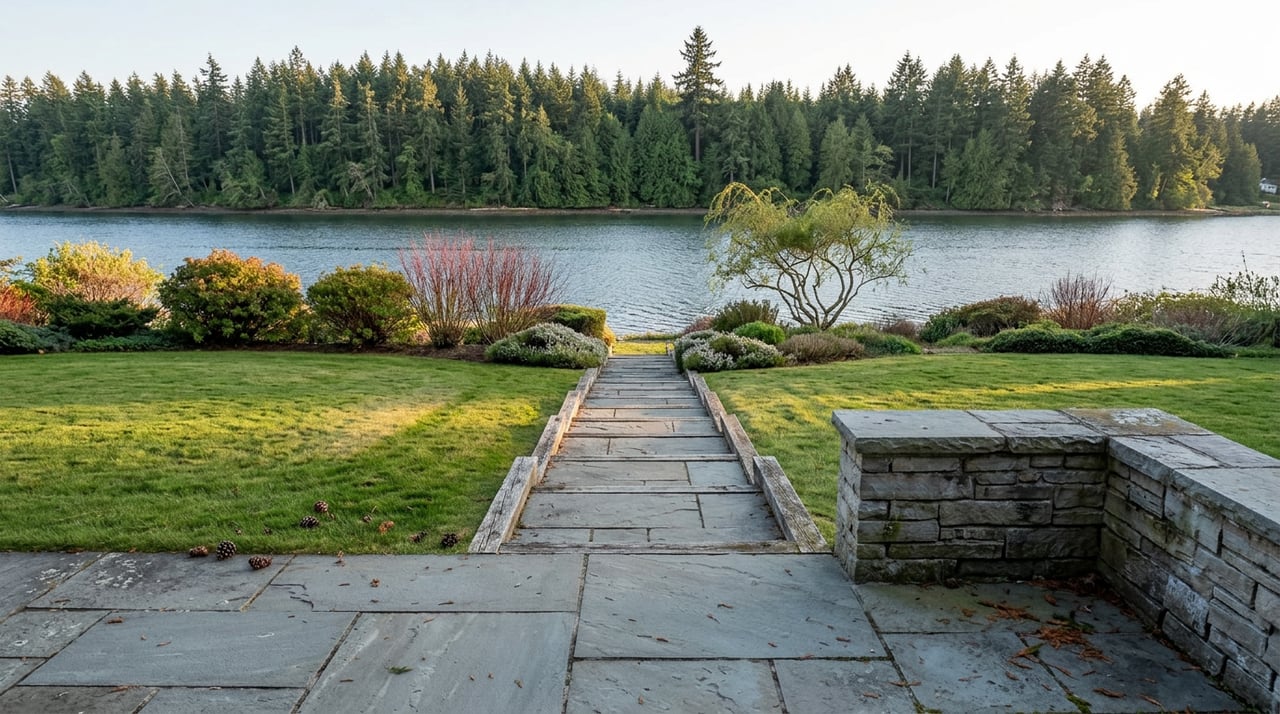
I've walked more than one buyer down to their new shoreline the week after closing, tape measure and landscaping wish list in hand, only to watch their face change when I explain what they can and can't do to the twenty five feet closest to the water. They own the lot. They do not, in the way most people assume, own the right to touch it.
That gap between "I bought waterfront" and "I control the waterfront" is the thing nobody explains until you're standing on it. It shows up when a buyer wants to clear brush for a better view, when a seller assumes a dock permit transfers automatically, or when someone hears the words Superfund site and assumes their closing just got more expensive. On Lake Coeur d'Alene, all three assumptions are wrong in ways that actually matter to your offer, your timeline, and in one case, your closing costs.
The Buffer You Don't Own the Way You Think You Do
Kootenai County's Site Disturbance Ordinance sets a shoreline management area of 25 feet in slope distance landward of the ordinary high water mark on Lake Coeur d'Alene and on the Coeur d'Alene and Spokane Rivers. Inside that strip, the county's own waterfront brochure is blunt about what the rule means in practice: the area has to stay in a natural state, with no excavation and no cutting of trees, grass, or shrubs, regardless of who holds the deed.
That surprises people because it runs against the instinct that waterfront ownership means unrestricted access to shape the view. It doesn't. The buffer exists on every recognized lake and river frontage in the county, which means it applies just as much to a modest cottage lot on a quiet bay as it does to an estate parcel with two hundred feet of frontage.
Not everything in the buffer is frozen, though. The ordinance carves out a list of activities that are permitted without triggering the full site disturbance process, and that list is worth knowing before you make an offer or plan a project:
| Typically allowed in the buffer | Requires a permit or a site plan |
|---|---|
| Stairways, walkways, and landings down to the water | New excavation or grading |
| Repair or replacement of an existing retaining wall or shoreline structure | Cutting healthy trees, grass, or shrubs within the buffer |
| Native or noninvasive plantings, including erosion-control vegetation | Fertilizing turf near the shoreline |
| Removing debris after a storm or wildfire | Adding new permanent structures inside the buffer |
| Small seating or picnic areas that don't disturb soil | Altering the shoreline itself without an approved plan |
The pattern underneath the list is consistent. Maintenance of what already exists is generally fine. New disturbance, even something as ordinary as thinning trees for a lake view, is not something you can assume your way into.
A Second Government With a Say in Your Dock
The county buffer is the layer everyone eventually learns about. The one that catches people off guard is jurisdictional, not physical. On the southern end of Lake Coeur d'Alene, inside the boundary of the Coeur d'Alene Reservation, docks, piers, boat garages, and similar structures fall under the Coeur d'Alene Tribe's Shoreline Protection Program rather than county rules alone. The Tribe's own materials describe nearly 535 permitted encroachments across the Reservation's waters, structures ranging from docks and boat garages to seawalls, breakwaters, and boat ramps, all of them built under a standard designed to protect access for dock owners and other lake users alike.
For a buyer, this means the same question, "can I build a dock here," has two different answer paths depending on exactly where the parcel sits on the lake. For a seller, it means the dock currently in the water may carry a permit history that a buyer's agent should confirm rather than assume. I've seen transactions slow down not because anyone did anything wrong, but because nobody checked which authority actually governed the structure until an inspection raised the question.
The Superfund Status That Works in Your Favor
Here's the part that runs opposite to what most buyers expect. Lake Coeur d'Alene sits inside the Bunker Hill Mining and Metallurgical Complex Superfund Site, one of the largest in the country, designated by the EPA in 1983 after more than a century of mining and smelting sent heavy metals downstream from the Silver Valley. Roughly 75 million tons of metal-contaminated sediment remain on the lake bed today, a legacy of mining practices between the 1880s and the 1960s. Say the word Superfund to most buyers and their instinct is to expect complications and cost.
The opposite is closer to the truth for anyone closing on a home here. Because the site is so well documented, the Basin Environmental Improvement Project Commission maintains free environmental disclosure records that sellers, agents, and landlords are required to provide, available online through the Institutional Controls Program without the private Phase 1 environmental audit that a comparable purchase outside the site would usually require. A recent Coeur d'Alene Press column on the program put it directly: one of the benefits of living within the Bunker Hill Superfund Site is that the recordkeeping already exists and the records are free to pull. The same program, run through Panhandle Health District, is also the one you'd contact before any shoreline digging that might disturb an existing clean soil barrier, since parts of the basin have engineered cover rather than full removal of contaminated material underneath.
So the pattern for a lakefront transaction here isn't extra scrutiny for its own sake. It's oversight that happens to make the paperwork side of closing faster and cheaper than it would be in a lake town without that infrastructure, paired with a genuine obligation to check before you dig near the water.
What This Means Before You Write an Offer
If you're evaluating a specific parcel on Lake Coeur d'Alene, the practical version of all this comes down to a short list of questions worth asking before your offer goes in:
- Where on the lake does the parcel sit, and does it fall within the Coeur d'Alene Reservation boundary for dock and shoreline permitting purposes
- If there's an existing dock, boat garage, or seawall, what permit history exists for it and does that history transfer with the sale
- Has the seller pulled the free environmental disclosure records through the Basin Commission's portal, and if not, who requests them and when
- Are there any planned improvements, a new retaining wall, additional dock space, cleared sightlines, that would fall inside the 25 foot buffer and need a site plan before work starts
None of these questions are deal breakers. They're the difference between a closing that goes smoothly and one where a buyer discovers three weeks in that the landscaping plan they had in mind needs a permit application first.
A Few Questions I Get Often
Does the 25 foot buffer apply to every lake in the area, or just Lake Coeur d'Alene? The county's shoreline management area applies to all recognized lakes in Kootenai County along with the Coeur d'Alene and Spokane Rivers, so the same rule reaches beyond Lake Coeur d'Alene itself.
Do I need a permit just to trim a tree near my shoreline? Routine pruning is generally allowed, but cutting a healthy tree down or clearing multiple trees for a view falls under the restricted activities and typically needs review first.
Does the Superfund designation affect financing or insurance? It affects the disclosure process more than financing directly. Because the environmental records are centralized and free through the Basin Commission, most buyers find the paperwork simpler rather than harder, though your lender may still ask questions the first time they see the site referenced on a title report.
Waterfront on this lake is still everything people move here for, the water access, the view, the quiet end of a summer evening on your own dock. Understanding the layers underneath the deed just means you get to enjoy it without a surprise waiting on the other side of closing.
If you're looking at a specific parcel, whether it's your first look at the market or you've had your eye on a stretch of shoreline for years, I'd rather walk you through what a particular lot actually allows before you fall in love with a plan that needs a permit first. Cindy Perry has spent her career in these neighborhoods and knows which questions to ask before you write the offer, not after. Let's Connect — Find Out What Your Property Is Worth.